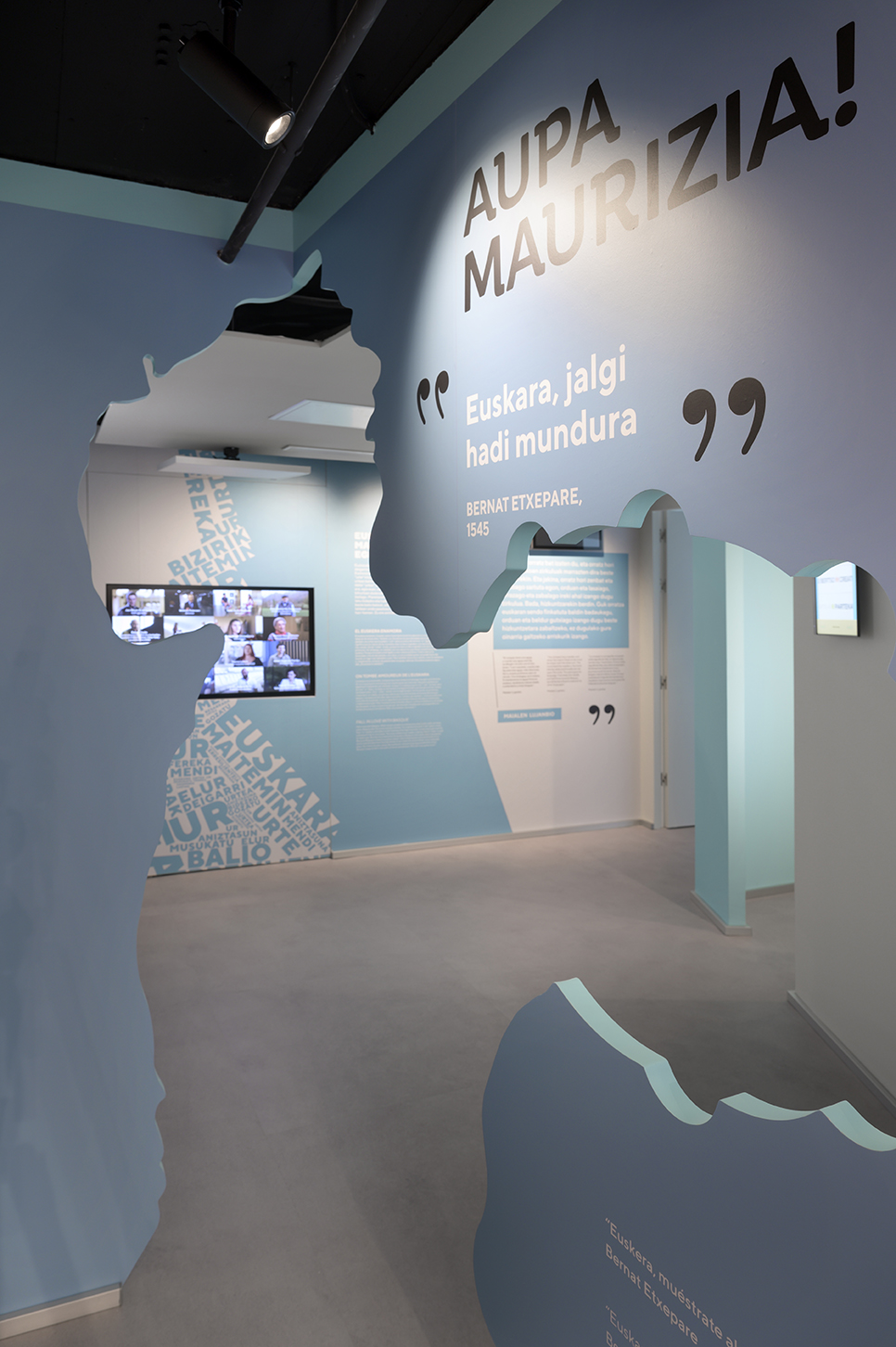


13. Add your voice to Basque!
This is the last area in the exhibition. It is called ‘Gehitu gugana’ or ‘Join Basque!’.
Here, people take centre stage. That is why you passed through the silhouette of Maurizia Aldeiturriaga, with her tambourine.
Maurizia was a very well-known woman who livened up the festive processions in many Basque towns by playing her tambourine. Her cry became very famous:
(We hear ‘Aupa Maurizia!’)
She represents everyone who keeps the language alive with their voices. Everyone who takes Basque out into the street and out into the world, just as Bernat Etxepare exhorted us to do in back in 1545, in his poem ‘Euskara jalgi hadi mundura’, ‘Basque, go out into the world’.
There are two important factors that will determine whether or not Basque continues to gain speakers in the future: usefulness and attractiveness.
● If Basque is useful, if we need it, if it forms part of our lives, then we will use and speak it more.
● And if it is also appealing, then it will attract and move us. We will view it as alive and necessary.
Bilbao-born writer Gabriel Aresti was the driving force behind the modernisation of the Basque language. He was an ‘euskaldunberri’ (literally a ‘new Basque speaker’) meaning that he learned Basque as an adult rather than as a child.
Aresti once wrote: ‘Who would ever say they loved bread? Bread is not loved; it is needed. The same is true for me and Basque: I do not love it; I need it.’
In this area you will discover that Basque unites, attracts and captivates people from all over the world.
In the photo booth, smile at Basque and take home a souvenir in the form of a ‘bertso’. In the next room, why not try your hand at singing?
‘Gozatu!’, ‘Enjoy!’